Sunday, April 29, 2007

Biodiesel supercar is Brit first

British firm Trident has broken the supercar mould with its new Iceni, by marrying stunning performance with economy and eco-friendliness.

The key to this triple achievement is the V8 diesel engine that Trident has sourced from GM to power the car, coupled to some clever gearbox engineering to make best use of the engine's monster torque.

The result is that, once installed in a lightweight sportscar as opposed to the Isuzu pick-ups in which the unit is usually found, the 6.6-litre 375bhp V8 can propel the Iceni from 0-60mph in 3.9 seconds, and on to 170mph.

So far, so supercar.

What's different is that this can be achieved while running the car on biodiesel, making the car capable of a planet and wallet-friendly 60mpg.

To prove their point, this month Trident is sending a car from the firm's Norfolk base to Monaco - on one tank of fuel.

Together with required engine service intervals at only every 100,000 miles, a three-year powertrain warranty and bodywork guaranteed against corrosion for life, the Iceni is set to be by far the cheapest supercar to run.

Trident also hold out the prospect of an 'R' model, developing the engine further to achieve a Ferrari-beating 550bhp and top speed of 230mph, cutting the car's 0-60 time to around 3 seconds.

So how much for a stunning 170mph supercar that does over 60mpg? The Iceni's a snip at £60,000 (or £75,000 for the Iceni R). That's the same price as a basic Porsche 911 or half a Ferrari F430.


Monday, April 23, 2007

Global warming?

Interesting story over on the EUReferendum blog today, contrasting the dire predictions from the "global warming scare industry" with problems being caused by unusually thick pack ice off Newfoundland's northeast coast.

While politicians would like to use the outpourings of the likes of Al Gore to justify hitting car users with extreme tax rises and putting unreasonable demands on the car industry, contradictory evidence such as this is seriously undermining their case.

Read more here.


Thursday, April 19, 2007

Size no obstacle to safety

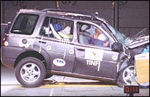
The latest version of Land Rover's smallest 4x4 model, the Freelander 2, has been awarded the maximum five stars for adult passenger safety by independent car safety experts Euro NCAP.

It also achieved an impressive four marks for child protection.

Land Rover claims the recently-launched Freelander 2's success is down to its special inner 'safety cell', which is protected by crumple zones front and rear and ultra high-strength door beams.

Occupants also benefit from seatbelt pre-tensioners and seven airbags.

The Suzuki Grand Vitara, also recently tested by NCAP, fared similarly well. Suzuki's compact 4x4 achieved a four star score for adult safety.

The Vitara also performed exceptionally well at pedestrian protection. Its three star score means it leads even many superminis in the pedestrian safety it provides in the event of a collision.

The results are a major set-back for the claims of anti-4x4 campaigners that cars like the Freelander and Vitara are unsafe simply because of their bulky styling or, even more irrationally, because they are driven through four wheels rather than two.


Wednesday, April 18, 2007

Brit-built Astras to stay

General Motors has confirmed that the next-generation Vauxhall/Opel Astra will be built in the UK.

GM's new 'family' of compact cars - to include the Astra, upcoming Saab 9-2 and a Saturn-badged model to go to North America - is scheduled for 2010, and will be made by Vauxhall's 2,200 employees at their Ellesmere Port plant in Cheshire, as well as at plants in Germany, Poland and Sweden.

However, production at GM's plant in Antwerp, which currently makes Astra variants including the estate and coupe-convertible, will be discontinued. Around 1,400 people will lose their jobs in Antwerp this year as Astra production is wound down.


Cowley builds millionth Mini

This month, the millionth 'new' Mini has been built at the brand's plant in Cowley, near Oxford.

The car in question was a Cooper S model in Pepper White, with a unique Almond Green roof and matching leather upholstery (pictured). It will be sent to Mini owner BMW's Mobile Tradition heritage division for use in promotional activities.

BMW currently employs over 4,700 people at the Mini factory in Cowley, where it has the capacity to build 200,000 cars a year. Production is set to increase to 240,000 when the new Clubman estate goes into production later this year.

Nearly 80% of Minis are exported. Mini sales continue to rise since the launch of the Mk2 version last November; 7,854 were sold last month, an all-time record.


Wednesday, March 14, 2007

EU chief's hypocrisy on car emissions

The president of the EU Commission, José Manuel Barroso, has been forced to defend himself against charges of hypocrisy for owning a so-called 'gas-guzzling' 4x4.

While driving a 4x4 is not an activity that someone can come under fire for on this blog, the problem lies in Barroso's abject double standards.

For himself, he chooses the safety, style and driving experience of a 4x4.

But at work heading the European Commission, he piously lectures us all about the urgency of cutting car emissions. Worse, he busies himself making excessive laws aimed at forcing the rest of us who aren't paid out of an apparently bottomless pit of taxpayers' money into tiny city cars, by steadily making anything else unaffordable.

Barroso, who owns a Volkswagen Touareg, said: "I have never spoken of myself as an example to anybody - today's moralistic approach is not mine."

But this is more than a tad rich, coming from the head of a body that, despite its democratic illegitimacy, constantly makes moral choices in a wide range of policy areas and enforces them on us all through EU-wide laws.

Barroso's VW 4x4 emits an above-average level of CO2 of 356 g/km - well above a 130g limit Brussels is seeking to impose on the car industry by 2012. Taken as a whole, the EU Commission's car fleet of 85 vehicles has an average emissions level of more than 258g/km.

Are they doing anything about that? So why should we make sacrifices in our choices?

'Collective action' EU-style

In response to the hypocrisy charge, Mr Barroso bizarrely insisted that fighting climate change was about "collective action" and voiced concern that a focus on an individual's CO2 usage could be a "slippery slope".

Yet most people would understand the simple idea that 'collective action' actually results from the choices of large numbers of individuals.


And few are likely to heed 'encouragements' to make certain perceived pro-environment choices when those doing the encouraging (or more accurately in this case, enforcing through EU law) don't take their own words seriously enough to act on them.

Euro corporatism exposed


Actually Barroso's response provides a chilling exposé of the corporatist mindset of those running the EU, in which 'collective action' comprised of individuals acting in common (for example, in voting for those who govern them) plays no part.

Rather, collective action EU-style is derived through the interaction of bodies taken to speak on behalf of groups of individuals. We individuals ourselves are expected to just do what the annointed 'collective' says.

Hence Barroso's idea that there's no need to focus on individuals, or being remotely credible in front of us.

Certainly, with such a 'don't drive what I do, drive what I say' mindset in evidence at the top of the EU and no appreciation of there being a problem in such an attitude, it's no wonder the EU-led way in which its member countries are increasingly governed is being described as 'neo-feudal'.


Tuesday, March 13, 2007

Rapide growth planned at Aston Martin

More Aston Martin news in The Times today, which reports that the company plans to step up production by more than a quarter in the next three years.

Growth will be driven by the start of production of two new models - the DBS of latest James Bond fame and the four-door Rapide - taking the marque's range to seven cars.

Ulrich Bez, chief exec of Aston Martin, said that the Rapide would add another 1,000 - 2,000 cars to its record 2006 total of 7,000.

The sportscar maker expects to take on at least 200 more workers at its Warwickshire plant as a result, with the facility having to be expanded with a new production line and developments to the body and paint shops.

Mr Richards reassured Aston Martin fans that the new owners were committed to the company long term and would not be seeking a quick turnaround like many private equity groups.

He said: “The car industry and this business require long-term investment. You can’t come in and out in two to three years as some private equity groups do.”

Ford also owns Jaguar and Land Rover in the UK, but Lewis Booth, head of Ford Europe, yesterday said that there were no plans to sell those companies too.

Aston Martin has very little in common with other Ford brands so was seen as the easiest to sell. Land Rover and Jaguar and Ford-badged cars share a great deal of parts and design.


Monday, March 12, 2007

Back to British

Luxury sports car maker Aston Martin is heading back into British hands. Ford have sold the company to a UK-led group for £479 million.

The buying consortium is led by Dave Richards, boss of respected motorsport specialist Prodrive.

The American car giant has had a big stake in Aston Martin since 1987, buying the company outright in 1994. Under Ford's ownership, the company reported record sales of 4,500 cars in 2005.

But with the onset of Ford's financial troubles, the group decided to sell Aston Martin. Ford lost more than $12bn in 2006, and faces huge restructuring costs. However the group has still held on to a £40 million slice of the company.

The sportscar specialist will remain at its purpose-built factory in Gaydon (Warwickshire), which employs 1,800 people.


Prodrive success

Under the leadership of Dave Richards, Prodrive has built a formidable reputation in motorsport, running the Aston Martin racing team in the sports car series around the world as well as the highly-successful Subaru rally team.

Dave Richards also managed the BAR Formula One team from 2002 to 2004, taking the team from eighth to second in the manufacturers world championship in that period, before Honda took a greater role in the team. Richards was also a leading figure in the Benetton F1 team in the late 90s.

Prodrive owns a slot to enter the 2008 F1 World Championship, but the consortium has called 'unfounded' speculation that Prodrive may now brand its cars Aston Martin.

Also in the consortium with Dave Richards is John Sinders - a banker in finance and shipping who spends his time between Texas and Dubai - and two Kuwaiti investment companies.

Future challenges


Looking ahead, the biggest question facing the new owners is whether, without the backing of a well-funded major car group enjoyed by many of Aston Martin's main rivals, the new owners will have enough cash to spend on developing the brand's cars to keep them ahead of the competition.

A further threat is looming EU car emissions regulations. If these are implemented on a per-manufacturer basis, that would present a major problem for independent sportscar makers unable to meet such rules by balancing the inevitably higher emissions of their products with the low-emissions city cars also produced by a large car group.

For the company to survive under such an imposed EU regime, huge investment would be needed to produce low-emissions powerplants that nevertheless maintain the required level of power and performance.


Thursday, February 08, 2007

EU emissions threat to Britain's car industry?

The European Union's new plan, announced yesterday, to enforce an average emissions limit on new cars of 130g of CO2 per kilometre could present a major threat to a large part of Britain's specialist car industry.

While the EU Commission has apparently assured car-makers that the new limit will not apply to each individual manufacturer but to the industry as a whole, the exact terms of how the plan will be regulated are yet to be set out.

But the EU has a long record of making reassuring noises when announcing a new plan, yet the final law turning out - many months later, when press attention has died down - to be far more harmful.

If the law does take a per-manufacturer approach, the major car groups could more easily meet the average emissions requirement using the smaller city cars in their range to offset the emissions of their larger products.

But specialist sports and executive car makers like Britain's Aston Martin, Land Rover and Jaguar, as well as Britain's wide range of independent sports car makers, could be under threat.

While the big three mentioned above are currently all part of the Ford group, that doesn't make them secure. In a likely foretaste of what may happen if this new EU proposal comes into force, Ford is already trying to sell Aston Martin.

The question is, under the new EU law, could Ford cope with the sports and executive cars produced by these British brands at the higher end of their emissions range dragging up their average?

The same question must be asked in the cases of Bentley and Rolls Royce, owned by Volkswagen and BMW respectively.

If these groups feel they've reached the limit of what they can achieve with low-emissions city cars, disposing of their luxury higher-emissions brands could easily become an option.

Yet tens of thousands of jobs in Britain are connected with the manufacturing operations of these car-makers.


Weight -v- emissions: EU contradiction


The EU has also been accused of contradiction in its approach to the car industry. Car-makers have made huge progress in engine efficiency in recent years, reducing average car emissions from 185g/km of CO2 in 1995 to 162 g/km last year, and aiming for 140g/km by 2008.

But this progress has been hampered to some extent by the size and weight of cars increasing, caused in large part by ever more stringent EU-derived car safety regulations. More crash protection built into a car means more metal being used and a heavier vehicle is the result.

Obviously making safe cars is also a priority, but there's no evidence of a joined up approach to regulation between achieving this objective and reducing emissions - as to whether ever more EU demands for vehicle rigidity are worth the extra weight and emissions that inevitably result, relative to whether road casualties could be reduced in other ways.


EU's big business bias


Consultation on this new EU emissions plan will apparently continue, but danger is present in the way the EU law-making process favours large corporations with multi-billion pound budgets and professional lobbying outfits in Brussels.

The major car groups will inevitably command more attention from EU institutions and may be supportive of this new plan, if they were to see it as an opportunity to consolidate their market position by turning up the heat on their smaller competitors.

Wednesday, February 07, 2007

'4x4s safer' says TRL

A new report by the Transport Research Laboratory - the UK's internationally recognised centre for transport research and testing - has blasted another of the arguments being touted by anti-4x4 obsessives clean out of the water.

In a study of the effectiveness of roadside safety barriers, TRL's research shows that 4x4s are involved in fewer impacts with crash barriers. Just two per cent of strikes involve 4x4s, whereas these cars make up 10% of cars on Britain's roads.

That means 4x4s are five times less likely to be involved in this type of collision.

The study also reviewed UK national accident statistics, which indicate that the drivers and passengers of these larger vehicles are less likely to be killed or seriously injured in an accident than those in other types of car.

It also points out that 4x4s are "under-represented in accidents on unclassified roads".

Commenting on the results, the Society of Motor Manufacturers and Traders pointed out that the results of the study were probably due to more 4x4s being fitted with accident avoidance technology like ESP (Electronic Stability Programme) as well as anti-rollover technology, assisted braking and lane departure warning systems to prevent skidding and loss of control.

TRL's findings follow a Department for Transport (DfT) report published in October last year, which examined 2004 accident data. That also revealed that occupants in a 4x4 were around half as likely to be killed or seriously injured in a two-car impact as those in other types of car.

While this report is no longer available to download from the DfT web site, copies can be requested from the DfT on +44 (0)20 7944 6395 or e-mail: roadacc.stats@dft.gsi.gov.uk .

So now that 4x4s have been shown to take up no more road space, are no more 'gas guzzling', are not more polluting, and are no more dangerous to their occupants than other average sized cars, will the anti-4x4 brigade finally admit that their bizarre obsession with these vehicles is more about an attempt to continue out-dated class war than any rational argument?


At the very least the mainstream media should now stop mindlessly repeating their failed arguments.


Friday, February 02, 2007

IPCC downgrades climate change effect by 25%

While this blog isn't necessarily concerned with scrutinising the theory that humans are causing global warming, today's renewed hysteria can't go without comment.

The latest IPCC report that's causing it will undoubtedly be leapt upon by politicians wanting to push through stinging tax rises and thinking 'saving the planet' may present a plausible justification. And typically such action is directed disproportionately at car users.

But the politicians had better think again. Because however much rhetoric about it 'ending debate' they might like to spout self-servingly, this latest report is very far from 'conclusive' evidence that there's a serious climate situation developing.

While the mainstream media obediently recites the usual gloom-and-doom scenarios, almost revelling in the potential horror, the only point that seems to be of real relevance is that the temperature estimates in this latest report have actually been downgraded by 25% from those given in the IPCC's previous offering.

Back in 2001, the IPCC's predicted upper temperature rise this century was 5.8C. By today's report the upper estimate had dropped to 4C.

This downgrade is being explained by the IPCC as a 'refinement', due to better quality data having being obtained. This is understandable.

But the IPCC have effectively admitted that their previous estimate was inaccurate to an astonishing degree. So what of their current estimates? Exactly why should they be taken so seriously?

Is it not within the bounds of possibility that better quality data still may cause further downgrades and reveal that there isn't that serious a climate problem looming at all?

A variation of the order of 25% suggests that a reasonable level of doubt about what we're being told by the IPCC on climate change should quite naturally remain.

Tuesday, January 16, 2007

Reports of the death of 4x4s greatly exaggerated

A bit before Christmas, The Times splashed their front page with the almost gleeful headline that 'Sales of 4x4s slump', blaming eco-hysteria and threatened tax rises by opportunist politicians and local councils for an apparent large drop in the sales of 4x4s.

By way of 'evidence' for the claimed slump, the report said that sales of 4x4s had plunged 'more than 15%' in November 2006, compared to November the previous year, and that sales 'have fallen in every month' in 2006, except March.

Predictably the anti-4x4 anoraks leapt on the report, claiming this was evidence that their absurd campaign against four wheel drive vehicles in particular was working - a knee-jerk reaction typical of their campaign as a whole, in that it overlooked some rather crucial facts.

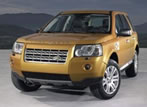
Because what Ben Webster of the Times omitted to say is that, in November, two of the top-selling 4x4s - the Land Rover Freelander (pictured) and Honda CR-V - were replaced with brand new models. Consequently, rather than buy in November, those wanting to buy one of these popular 4x4s quite naturally waited instead until the new model was available.

So in this context the 15% drop in November's sales was actually not surprising at all.

The report also neglected to put the supporting claim that 'sales have fallen every month' in context of the declining market in new car sales during 2006. In reality 4x4 sales for the whole year fell 6.2% on 2005 numbers, while the whole new car market fell 3.9% during 2006. So 4x4 sales actually fell only by a further 2.3% more than all new cars generally.

That's hardly a 'slump', and is in fact most likely to be a distortion caused by three major model changeovers during 2006 - those mentioned above in November, plus the Toyota RAV4 that was replaced earlier in the year - during which supplies of vehicles to customers were interrupted as stocks of old models were run out.

In a further blow for anti-4x4 obsessives, both Land Rover and Jeep - makers of some of the biggest 4x4 vehicles on the market - announced record sales during 2006. Jeep’s overall increase was 22.6%, sales of the Range Rover Sport increased by 52% and the Range Rover by 12.5%.

And mass market car-makers Peugeot and Citroen also released plans to enter the 4x4 market with the brand new 4007 and C-Crosser models, expected in showrooms this summer.

The one redeeming feature of the Times article was seeing the RAC Foundation speak out in defence of 4x4s, saying quite rightly that much of the criticism such cars get is ill-informed because some smaller models, such as the Honda CR-V and Toyota RAV4, are more fuel efficient than many people carriers and large saloons.

Edmund King, the foundation’s director, said "The demonisation of 4x4 drivers has been unfair because many chose one after considering the safety of their kids."

It's certainly about time they and the AA Motoring Trust started taking a more robust line in defence of the increasingly hard-pressed car user.


Thursday, November 30, 2006

More interested in pounds than planet?

Far from the bogeymen eco-extremists make them out to be, car makers are crying out for the government to provide real incentives for people to switch to their greener products.

But rather than enabling people to make an affordable, more environmentally-friendly choice, all allegedly 'green' politicians seem interested in so far is ways to increase taxes and wring more cash out of already financially hard-pressed car users.

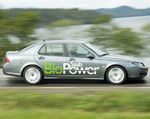
Saab MD Jonathan Nash is the latest to appeal for the government to take action to boost the emerging bioethanol fuel industry. Speaking at the launch of Saab's second flex-fuel car – the Saab 9-5 2.3t BioPower – Nash said that CO2 emissions could be cut by as much as 70%. Yet incentives for buyers in the UK were not available.

He has joined Ford, which makes the Focus FFV, Morrisons Supermarkets and the National Farmers Union in asking for the Chancellor to include incentives in his 2007 budget.

Joining the growing chorus pointing out the government's hypocrisy, Nash said, "Upon publication of the Stern Review the British government claimed to be leading the global debate on climate change. Well I don't see much evidence of that.

"What I see is the Swedish government taking progressive measures, such as major tax relief at the pump and for company car drivers, and free parking in Swedish cities to encourage drivers into environmentally friendly cars, instead of penalising them."

Those politicians professing concern about the environment but only proposing ramping up taxes on car use to ridiculous levels can only be trying to pocket more of our pounds rather than save the planet.

A real demonstration of their professed conviction about the dangers facing the planet would be acting on the fact that a far more speedy and effective reduction in carbon emissions could be achieved if they reduced their tax take on environmentally-friendly products to make them more affordable. And not just in transport.

When they show a willingness to do this, then maybe they can expect their lectures about global warming to be taken more seriously.


Wednesday, November 29, 2006

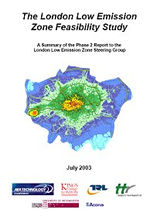
London Low Sense Zone

The likely harmful effect on Londoners' health of Livingstone's policy of piling more and more buses onto London's overcrowded streets is admitted in the info on his latest scheme - a London
Low Emission Zone.

Announcing a 'consultation' on the plan, the press release says "A Low Emission Zone scheme would aim to improve London's air quality - and thereby improve Londoners' health - by encouraging operators of large diesel vehicles to clean up their fleets".

Later, Ken himself is quoted as saying "The proposed Low Emission Zone is the most effective way of quickly reducing pollutants that are among the most harmful to human health."

But who's causing all the emissions of diesel pollutants, as Ken says, 'among the most harmful to human health'? Is it really private operators of 'large diesel vehicles'?


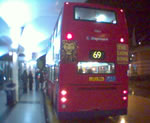
A main culprit has to be the 8,000-strong fleet of London buses which travel millions of miles in London - stopping, starting and lingering in densely populated areas - for which Livingstone himself is ultimately responsible. A fleet that has rapidly increased in number since he came into office.

More buses, more emissions

Increasing the frequency of service on bus routes inevitably increases the amount of diesel exhaust in the air. Even using newer buses with cleaner diesels can produce similar total exposures as the old, less frequent service with older engines.

It's also the case that finer particles from newer diesel engines can enter the body much more easily than the coarse particles from older engines, so may actually represent a greater health risk.

But what's Ken's response on seeing that health-threatening diesel pollutants are predictably on the rise as a result of his actions? Launch a study into whether further expansion of bus services is really necessary or worth this cost to human health, and moderate his actions accordingly? Regardless of the health implications, many may see this as a good idea anyway, given the number of buses trundling around these days with next to no-one on board.

But no. In typical Ken style, someone else is getting the blame - and their wallets raided for their 'crimes'.

Just like with ordinary car users and the 'congestion' charge, under the LEZ scheme private operators of larger vehicles are going to find themselves slapped with fines or the costs of changing their vehicles in order to compensate for Ken's unnecessary pollution.

Not taking responsibility

As usual, the most "effective" action to Livingstone is apparently not doing more in areas that are his own responsibility - a massive and increasing source of diesel emissions - but setting up elaborate and expensive schemes to confuse, interfere with and pocket cash from everyone else, delivering large profits to his new corporate 'comrades' like Capita in the process.

Showing at least an awareness of this hypocrisy, lurking at the bottom of the press release is the claim, "Through the fitting of particulate traps, all London buses under contract to Transport for London now meet a minimum of Euro III emission standards for particulate matter."

However, that statement
rather contradicts this BBC article from September, saying that the traps that had been fitted have made harmful bus emissions massively worse, quoting a Mike Weston of London buses saying that the problem won't be corrected for two years yet.

So who's telling the truth?


Tuesday, November 28, 2006

Mayor's lip service to tackling health threatening bus pollution

Also interesting about Livingstone's recent press release announcing the complete transformation of the London congestion charge into an emissions charge scheme, and its £25 daily top rate for many ordinary family cars, is the self-conscious mention in the last paragraph of London's buses.

Diesels may well emit less CO2 than petrol vehicles and this is what blinkered adherents to the global warming theory obsess about at any other cost.

But they are far worse for ground-level pollution, emitting greater quantities of substances like nitrogen oxide and far more particulates that have a direct negative effect on human health, particularly on those already ill or suffering respiratory problems.

Is the global warming theory, or even the human influence on climate change, well proven enough to justify this harmful trade-off? We'd better be sure, as it's undoubtedly costing lives.

In London, buses are the worst culprit of all for such pollution. Now numbering 8,000 - many more since Livingstone became mayor - they travel tens of thousands more miles a year each than any private car, they frequently stop and start, and often stand stationary for extended periods in densely populated places.

They are also a singly managed pollution source - proprietor, one Ken Livingstone.

So what's he doing about his rapidly growing 'fleet' of heavy-use polluters before lecturing families about their cars and hitting them with absurdly high charges for daring to use them?

In the press release he grandly announces that "We are already cleaning up London's fleet of public vehicles through measures like the introduction of Hybrid buses". Really? So how many of London's 8,000 buses are currently hybrids? Well, according to an earlier press release, a grand total of six.

Sorry, but such paltry efforts are no excuse for continuing to hammer car users as the big culprits for harmful emissions. Far greater progress must be made to tackle the massive source of visible ground-level pollution under Livingstone's control that is these 8,000 buses, before ramping up the costs for ordinary family car users to extraordinary levels like £25 a day can possibly be justified on 'green' grounds.

Has Livingstone now become so obsessed with meddling in other people's lives to get the responsibilities of his own job in order? The evidence is certainly mounting.

Tuesday, November 14, 2006

Livingstone writes off family vote with £25 'congestion' tax plan

Not content with offending both London's
gay and Jewish communities, along with being accused of making other racist jibes, Ken Livingstone now intends to finally dispense with the vote of London's family car users.

Today he formally announced his plan to
treble the London congestion charge to £25 for cars in tax band G - those emitting more than 225g/km of CO2. He'll also be ditching the 90% resident's discount for users of these cars, meaning that if any moves their car past one of the cameras within the charging times they will be hit with the full £25 tax.

The charge is expected to be possible from 2009, but Livingstone apparently wants to start it earlier.

Another 'green' tax misdirected

But far from targetting the 'wealthy', owners of large and expensive cars, or the oft-mentioned '4x4s', this extreme charge plan will in reality hit many owners of ordinary small to mid-size family cars and, particularly, people carriers.

Even some models of the following very average cars with certain engine sizes - just two litres in some cases, especially if automatic - will be hit by these extreme charges: the Audi A3 hatchback & A4 saloon, BMW 3-series upwards, Citroen C8 MPV, Kia Sedona MPV, Lexus IS small saloon, Mercedes's C-class smallest saloon model upwards, Peugeot 407, Renault Laguna & Espace, Seat Alhambra MPV, Toyota Previa MPV, Vauxhall Zafira MPV, Volkswagen Sharan MPV, Volvo V70 estate and others. The SMMT have produced a more precise list of examples.

So contrary to the media hype about 4x4s, this new congestion charge is actually more of an attack on family cars and MPVs.

New £25 charge hits families hardest

This of course makes a complete mockery of Livingstone's claim that "Most vehicles that will be charged £25, in vehicle excise duty band G, are high-priced models."

And it's hard to see why this warrants the glee of the London Green Party in calling this excessive financial persecution of families "fantastic news" or of Richmond Council (of 'green' parking permit con fame) in calling it "tremendous news". What planet are these people on - and who votes them in?

Worst of the bunch, This is London reports, has to be some non-entity called Geoff Pope - apparently Liberal Democrat (surprise, surprise!) chairman of the London Assembly Transport Committee. He proudly displayed his ignorance by saying, "Urgent action is needed to tackle the growing number of 'Chelsea tractors' coming into central London. They are damaging and unnecessary vehicles in a densely urbanised 21st century city."

Why, Mr Pope? When most are no bigger (except in height - is that terribly 'overcrowding'?) and no more polluting than many average family cars?

Is it too much to expect the chairman of the Transport Committee to scrutinise a car magazine and get the facts about sizes and performance of 4x4s relative to other cars? If he can't manage even that, who knows what other damage he's doing in his position. The man should be removed from his post for gross incompetence.

It was left to the National Alliance Against Tolls to make a sensible and practical point in the BBC report, in saying, "Band G cars will pay more from 2009, but that band only relates to cars registered after 23 March 2006, so it could have a perverse effect by encouraging the use of older vehicles."

Congestion charge or local car tax?

This latest move also signalled a conversion of the charging scheme away from focussing on congestion into more of an additional London car tax operating on similar emissions-based lines to the national car tax system. Is this what Livingstone was elected to impose on London?

In targetting people-carriers worst of all, this £25 charge plan is likely to actually make congestion worse.

Take school runs in the congestion charge zone. The school run is a major factor in road over-crowding, its absence at holiday times having a noticeable effect on how busy roads are.

Instead of those with larger cars like MPVs being able to do a school run for several families and take up to six kids to school, they will likely have to ditch their MPV to avoid the extreme charge and use a car with far less space. So more than likely multiple extra cars will be on the road doing the school run, to ferry the same number of kids.

More cars on the road

And if the scheme is 'successful' (on its own terms) in encouraging people to take advantage of the proposed zero charge for tiny or hybrid cars, then free access to central London roads would surely make them busier.

So it's hard to see what this new 'emissions-based' congestion charge will have to do with congestion at all. It clearly needs a new name too.

The widespread oppressive effect of this plan will be compounded by the westwards extension of the 'congestion' charge zone from February next year, targetting thousands more families with the extreme £25 charge.

We're supposedly reassured that this planned change is all 'subject to consultation'. That's of course what was said about the plan to extend the original charge zone. More than 80% of businesses and 70% of residents spoke out against the extension in that 'consultation', yet Livingstone is doing it anyway.

That's democracy in Livingstone-land. Ignoring the clearly expressed views of the people and imposing his ill-considered and un-wanted schemes regardless. No wonder he's such a fan of Cuba.


Wednesday, November 08, 2006

The BIG question

Two contributions to the debate on climate change on last week's edition of BBC1's Question Time deserve to be recorded in print.


First Peter Hitchens, who courageously read the riot act to the QT audience and left them reeling when they dared to groan at his questioning of the cosy climate change 'consensus'. He said:

"There is as yet no firm knowledge among scientists - no agreement among scientists - as to whether global warming is connected with human activity... (audience groans)

"...I'm sorry...it is...I've stated a simple fact. Scientists disagree about this. And if you can't accept it, and if you howl about it, you're in the grips of some kind of religious mania. There is no proof. It doesn't exist.

"There is an argument among scientists, and those scientists who object to the idea that there may be a connection between global warming and human activity are actually persecuted by other scientists, and subjected to inquisitions, such as Bjorn Lomborg. And it is very difficult for them to do so and their courage is to be applauded.


"But to moan and groan when somebody says something unfashionable is just to use the mentality of the herd of sheep. It is the case that we do not know.

"And we are being.... Just as Charles Clarke here tries to panic you, or tried when he was in office, to panic you into abandoning centuries of English liberty on the grounds of a terrorist bogey, the climate change people want to panic you into handing over large amounts of your money on the grounds of a climate change bogey.

"Be very, very wary of it. Be sceptical. Think about it. Don't accept what you're being told simply because somebody says 'I know'."


And a bit later...

"All that you will do if you try and restrict industry here on the Kyoto basis and on heavy taxation is you will transfer more industry to China and India and impoverish the West.


"If that's what you wish to achieve, great. But it doesn't seem to be - on the basis of an argument which is by no means resolved, is very complicated, and which most people think they know about and don't - it doesn't seem to me to be very wise to embark on a huge economic revolution on the basis of an undecided argument in science."

Second, notable in contrast only for its blatant hypocrisy, Lib Dem leader Menzies Campbell said: "There is no need to increase the overall tax take".

Really Ming? What's this all about then?


Friday, November 03, 2006

Honda hits back against anti-4x4 lobby

Car makers are starting to fight their corner against the irrational victimisation of 4x4s and their drivers being encouraged by a small minority of anti-capitalists masquerading as 'green' campaigners.

In the first case of a car maker communicating with their customers on the 4x4 debate, Honda have revealed that they will be sending a special campaign pack to all owners of their new CR-V (pictured).

The pack will demolish some of the key complaints of the anti-4x4 lobby and provide a special window sticker for them to display, promoting the message that 'Not all 4x4s are the same'.

Tallying strongly with earlier postings on this blog (What's Ken's real problem with 4x4s?), the campaign pack hits the 4x4-obsessives with some killer facts:

Too dirty?
The new Honda CR-V is not only cleaner than other SUVs - its exhaust emissions are lower than some large estates, hatchbacks, MPVs and even a Mini Cooper S!

Too big?
The CR-V has a footprint that's a similar size to a Ford Mondeo (and smaller than a BMW 523iE).


Too dangerous?
The current CR-V achieves a 3-star rating for pedestrian safety - which, according to industry experts Euro NCAP, puts it in the top 10 per cent of pedestrian-friendly cars on the road. Also, the current model gets 4-stars for occupant safety.

Commenting on the new campaign, John Kingston, Environment Manager at Honda UK, said "The 'one size fits all' approach of Anti 4x4 protesters is confusing. Some customers have expressed their concerns and frustration about being criticised for driving a CR-V - no surprise when you consider this Honda is incredibly clean, not a gas-guzzler, smaller than most 4x4s and is remarkably safe for both passengers and pedestrians."

Now all that's needed is for the mainstream media to wake up to the facts on this issue and to stop mindlessly repeating the baseless rhetoric of the anti-4x4 brigade.


Thursday, November 02, 2006

Green car industry leads the way

It's never mentioned in the gloom and doom stories about the environment, and eagerness to blame cars and their users for the alleged looming climate problems, but Britain's car industry is in fact leading the way in making their manufacturing activities and products kinder to the environment.


According to the Society of Motor Manufacturers and Traders (SMMT) Report on the 2005 Market, the average new car sold in 2005 emits 10.7% less CO2 than one registered in 1997. What's more, the percentage of new cars with CO2 emissions of under 140 g/km has risen to 18%, up from 3.9% in 1997.

Over half the new car market is now under the 160 g/km CO2 level, having fallen by more than 20 g/km per new vehicle since 1997. And despite a 15% increase in the total cars on the road since that year, total emissions from cars has fallen by 1%.

Those really concerned with improving our environment - as opposed to those who merely use it as an excuse to demand higher taxes or have a pop at the 'wealthy' - will be delighted to learn that improvements at Britain's car manufacturing sites have been even more significant.

Another SMMT study, Motorfacts 2006, reveals that energy used to produce each vehicle in the UK has been almost halved in just four years and, even better, the waste per vehicle produced sent to landfill has been cut by more than 70%.

Specific projects also show how hard car-makers are working to reduce their impact on the environment. As noted in a previous posting on expansion of the UK car industry, Ford is investing
£1 billion in developing new fuel-saving engines and systems at their UK technical centres, towards creating cars capable of 70mpg and emitting less than 100 g/km of CO2.


Last month, Auto Express reported that Toyota is joining in by switching the transport of raw materials to its Burnaston plant in Derbyshire from lorries to trains. And since last year Nissan's plant in Sunderland has been generating 5% of its energy needs with
wind power. Though the six 200ft turbines installed at a cost of
£2.3 million were reduced to five in December last year when one
burst into flames and its 75ft blades dropped off.


So rather than victimise the car industry and make extreme tax proposals that would likely harm a significant British industry and put thousands of people out of a job, those concerned about the environment and climate change should be offering congratulations and encouragement for this clear progress.


Tuesday, October 31, 2006


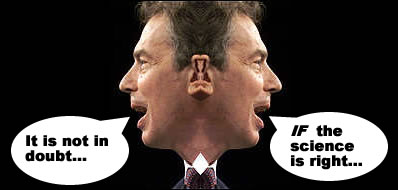
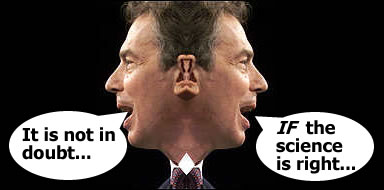
"It is not in doubt that if the science is right, the consequences for our planet are literally disastrous."
Tony Blair, speech at the publication of the Stern Review on climate change,
30 October 2006


'If' the science is right, Tony? IF? So there's still, erm, doubt?

Blair claims that the scientific evidence for global warming 'caused' by greenhouse gas emissions is 'overwhelming'. But clearly not overwhelming enough to prevent him hedging his bets and putting that 'if' in his speech.

With doubt over the scientific evidence for the human effect on global warming still evident at the top of government, it would obviously be totally unacceptable for the government to now try slapping extra, highly repressive taxes on people using the excuse of that evidence.

Such a move could now only be seen as driven by one agenda - using global warming as an excuse to simply increase the government's tax income.

You could say - IF the Stern Review was supposed to provide the justification for hitting people with higher taxes in the name of combating global warming, Blair's comments have put paid to that.